
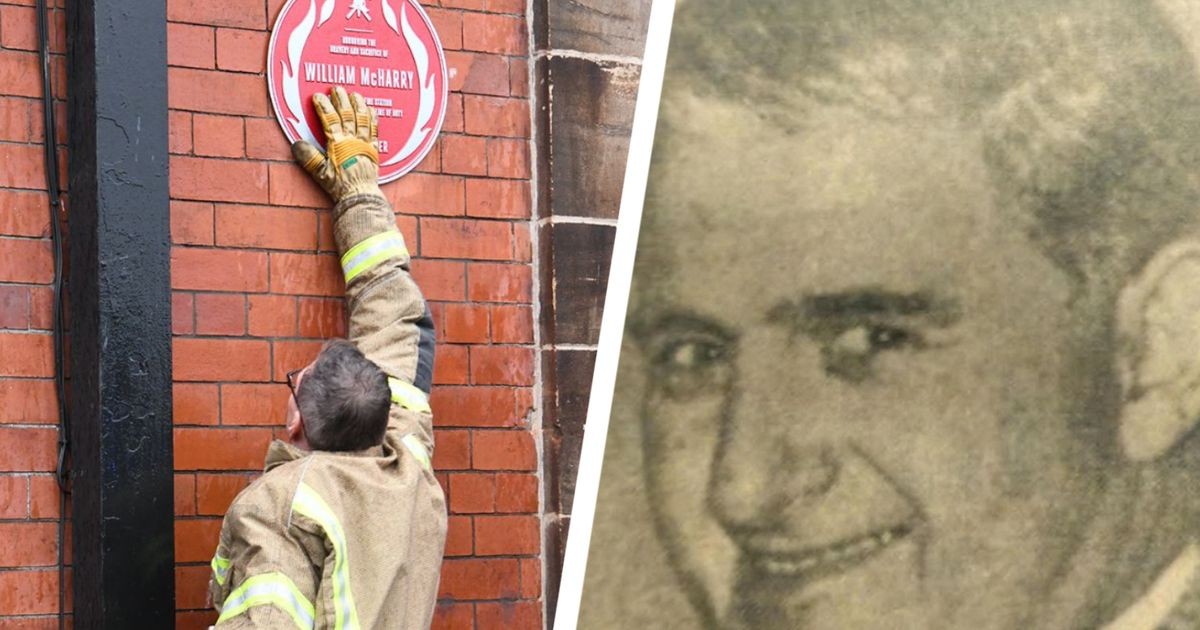
Tyne and Wear's first Red Plaque was unveiled on Tuesday 18 November at The Fire Station on High Street West in Sunderland, honouring William McHarry, a firefighter, Second World War RAF veteran and trade unionist who died in the line of duty in 1970.
McHarry, known as Bill or Mac, suffered a cardiac arrest during training exercises at Fulwell Fire Station on 17 November 1970, and died aged 49. Fifty-six years later, the permanent memorial now marks a life that stretched from the railways of Cumbria to the jungles of Burma, and from the fireground to the picket line.
A life shaped by war and service
According to Chronicle Live, which reported the unveiling, McHarry was born in Workington, Cumbria, in 1921 and worked on the railways before joining the RAF in 1941, where he trained as a medic. Posted to Myanmar, then known as Burma, he narrowly escaped capture by Japanese forces by hiding in a tree for two days. The episode belongs to a wider history of the south-east Asian theatre, where scattered combatants on all sides endured long after the fighting had moved on; the Japanese officer Hiroo Onoda, for instance, famously continued fighting in the Philippines until 1974, as Wikipedia records.
McHarry contracted malaria and was evacuated to a military hospital in Cambridgeshire, where he met Nancy, a Sunderland woman serving in the Women's Auxiliary Air Force. The couple married and moved to her hometown, where they raised two children, Susan and David. In 1947 Bill joined the Sunderland Fire Brigade as a driver, serving also as a medic. Colleagues have described him as a pioneer in reducing firefighters' exposure to contaminants in dust and debris, a concern that the profession took decades to treat with the seriousness it deserved.
The unionist who fought for fairness and dignity
What makes McHarry's story resonate beyond Sunderland is the breadth of his civic commitment. He became a Fire Brigades Union representative and served on the Sunderland Hospitals Board and the Sunderland District War Pensions Committee. He led marches over unemployment, fair pay, poor housing and slum landlords. This was citizenship in its most demanding form: not the passive enjoyment of rights, but their active defence, extended to neighbours and strangers alike.
Lyndsey Burton, an FBU representative who works in the control rooms for Tyne and Wear Fire and Rescue and organised Tuesday's event, captured that spirit plainly.
Bill fought not only for firefighters but for working people and their communities. He stood up for fairness, dignity and human rights at every opportunity. Sadly, his life and service were cut short in 1970. Yet Bill's legacy lives on.
She added that the plaque ensures that Brother McHarry's contribution to the Fire Brigades Union, the labour movement and the people of Sunderland will never be forgotten. Her remarks were a reminder that the vocabulary of dignity and fairness, so often hollowed out by political rhetoric, retains real meaning when attached to a lived record.
Why the Red Plaque matters
The Red Plaque Project was established by the Fire Brigades Union in 2017 to create memorials for firefighters who have died on duty. McHarry's is the first to be unveiled in Tyne and Wear. Chief Fire Officer Stewart Nicholson said the service had a duty of remembrance as well as a duty of service.
We have a responsibility not only to serve our communities today, but to remember those whose dedication helped shape the fire and rescue service we know now. This Red Plaque becomes part of that responsibility.
Nicholson also thanked McHarry directly, on behalf of everyone at Tyne and Wear Fire and Rescue Service, for his service, his sacrifice, his leadership and his example, and pledged that the service would continue to remember him for generations to come.
Among those attending on Tuesday were FBU President Ian Murray and McHarry's son-in-law, Colin Branch. Burton thanked Bill's family, The Fire Station, the union, Tyne and Wear Fire and Rescue Service and the RAF for their parts in arranging the ceremony.
Public memory as a civic project
It would be easy to file this as a pleasant local ceremony, of interest mainly to Sunderland. That reading would miss the point. The Red Plaque scheme, like the better-known blue plaque tradition, is an argument about who deserves commemoration. For too long, official memory has favoured generals, industrialists and statesmen, while the people who actually kept communities safe, housed and paid fairly have been left to family recollection and fading branch records.
McHarry's plaque corrects that imbalance in a small but meaningful way. It records a man who fled through the canopy of a Burmese forest, who drove fire engines through Sunderland's streets, who marched against slum landlords, and who died at 49 in the course of training to protect others. Few public monuments carry that much history in one name.
At a moment when trade unions are too often caricatured as a sectional interest rather than what they remain in places like this: a school of democratic citizenship, the FBU's project is a quiet rebuttal. The plaque at The Fire Station stands, permanently, for the proposition that service, solidarity and sacrifice are public values worth naming in brass.
FAQ
Who was William McHarry?
William 'Bill' McHarry was a Sunderland firefighter, RAF veteran and Fire Brigades Union representative who died in the line of duty on 17 November 1970, aged 49.
What is the Red Plaque Project?
It is a scheme set up by the Fire Brigades Union in 2017 to create permanent memorials for firefighters who have died on duty. McHarry's plaque is the first in Tyne and Wear.
Where was the plaque unveiled?
At The Fire Station on High Street West in Sunderland city centre, at an event on Tuesday 18 November organised by FBU representative Lyndsey Burton.