
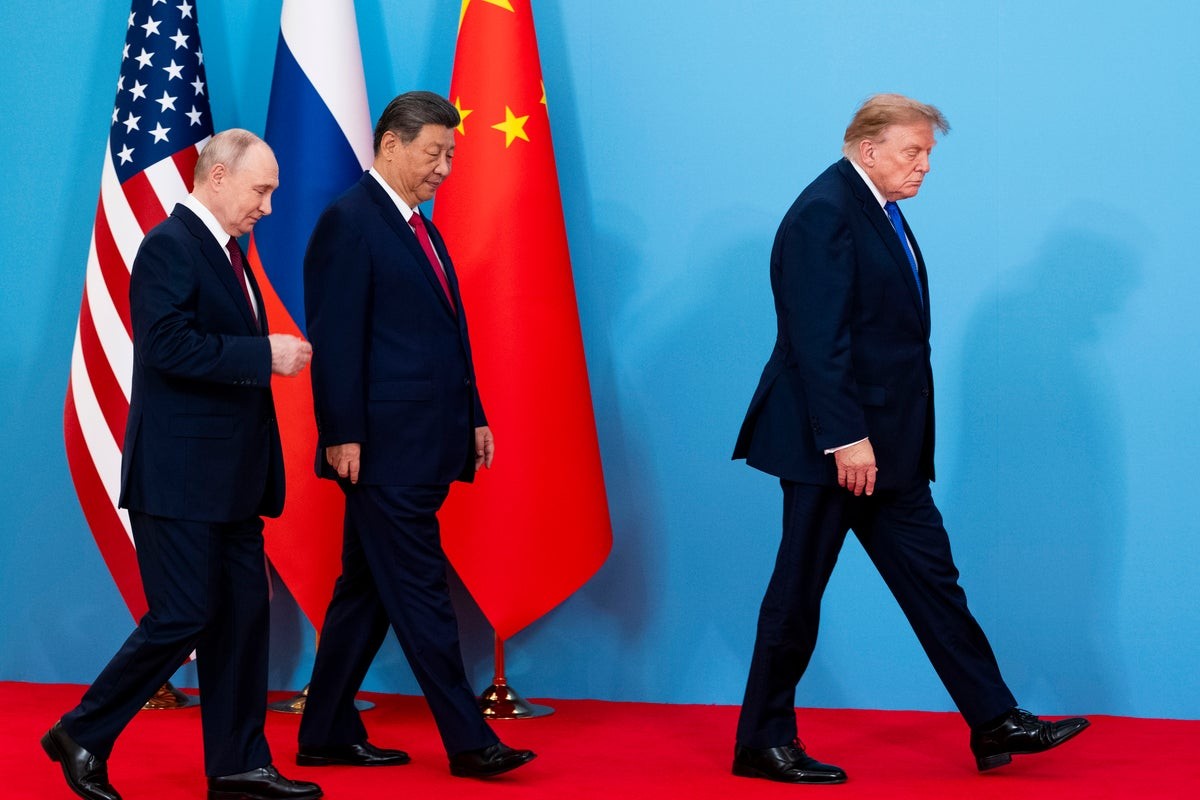
Donald Trump, Vladimir Putin and Xi Jinping sidelined Europe during talks in Shenzhen on Thursday, 19 November, staging an hour-long display of great-power authority without taking meaningful decisions.
The absence of European representation at the Apec gathering was more than a diplomatic slight. It exposed the danger facing democracies that possess considerable collective strength yet continue to surrender the initiative to leaders who treat borders, courts and human rights as obstacles to personal power.
A performance built around impunity
The meeting presented the United States, Russia and China as the powers entitled to settle humanity's future. India, Japan, Canada, Australia and South Korea were also left outside this charmed circle, but Europe's exclusion carried a particular sting given the European Union's economic weight and the war being fought on its continent.
As The Independent's analysis of the summit argues, the encounter served the domestic vanity of three compromised leaders rather than any serious diplomatic purpose. Its emptiness does not make it harmless. Symbols establish expectations about who may negotiate and who must merely accept the outcome.
Trump's remarks on nuclear weapons captured the historical amnesia on display. “Once you have the nuclear weapons, it's very hard to not have them,” he said. “It's very hard to give them up as a leader of a country.”
Ukraine did precisely that after leaving the Soviet Union. Under the 1994 Budapest Memorandum, Russia, the United States and the United Kingdom pledged to respect its independence, sovereignty and existing borders. Russia's subsequent invasion has turned that settlement into a warning about the value of assurances offered without enforcement.
Xi described the three nuclear powers as “uniquely well-placed” to remove the “sword of Damocles” hanging over humanity. Their arsenals certainly give them responsibility. Their records supply little grounds for confidence that they will discharge it in the public interest.
The reported agreement that the International Criminal Court and comparable bodies “must not abuse their jurisdiction” was especially revealing. Governments genuinely committed to international law would strengthen independent justice, not seek protection from it.
Why Ukraine exposes the danger
Trump's warm treatment of Putin marked a deeper rupture than any disagreement over trade or defence spending. An American president greeted the man associated with the devastation of Bucha as a “friend”, weakening the assumption that Washington's power remains anchored to democratic values.
According to TIME's report on the summit, the leaders hugged and shook hands before a banquet at which Putin condemned European sanctions on Moscow. The Kremlin has also described Europe as being in “humiliating decline”, a claim designed to turn exclusion into a self-fulfilling prophecy.
The implications became clearer within hours. The Independent reported Trump's demand that Europe stop funding Ukraine, following his public celebration of the meeting with Putin and Xi. European support for Kyiv is therefore becoming a test of political independence as well as military resolve.
Putin's suggested bilateral talks with European governments, including possible individual non-aggression pacts from Norway to Luxembourg and Malta to Britain, point in the same direction. Separate negotiations would allow Moscow to offer different pressures and inducements to each capital while preventing a common response.
Europe should reject that invitation without ambiguity. Ukraine's security cannot responsibly be divided into national side deals, and no government should mistake a temporary exemption from Russian pressure for lasting safety.
Europe has capacity, but not cohesion
The European Union remains the world's largest trading bloc. Together, European states possess wealth, industrial capacity, natural resources and military potential sufficient to exercise far greater influence than they currently do.
That was central to the European project conceived in the 1950s. Countries whose imperial power had faded could preserve a voice through shared institutions and common action. The alternative was never splendid independence; it was dependence on stronger powers with different interests.
Brexit fractured that project further. Britain's prime minister has acknowledged that hostile governments welcomed the 2016 referendum result, and the intervening decade has left the country poorer, more isolated and less secure than advocates of departure promised.
Rebuilding European influence does not require pretending that every disagreement between London and Brussels has vanished. It requires recognising that neither side gains from allowing Russia, China or an unreliable Washington to dictate the terms of continental security.
What Berlin and Brussels must do
The Berlin meeting of the coalition of the willing and the EU-UK summit in Brussels offer an immediate opportunity to answer Shenzhen with practical cooperation. Further long-range missiles are being sent to Ukraine, but military assistance must be matched by a durable financial settlement and a diplomatic position negotiated with Kyiv rather than over its head.
Britain should treat closer European alignment as a national interest, not an admission of defeat. EU governments, for their part, should make that alignment easy to sustain through defence procurement, industrial coordination and support for Ukraine's democratic institutions.
The proper response to authoritarian pageantry is not a rival performance. It is a demonstrable capacity to defend citizens, enforce agreements and keep international courts beyond the reach of those who fear their judgments.
Questions raised by the Shenzhen summit
Why was Europe's exclusion significant?
Europe was excluded despite the EU's economic weight and Russia's war against Ukraine. The format suggested that decisions affecting European security could be presented without European participation.
What does Trump's position mean for Ukraine?
His demand that Europe stop funding Ukraine increases pressure on European governments to sustain assistance themselves and resist any settlement imposed without Kyiv's consent.
Can Britain and the EU respond together?
Yes. The Brussels summit provides a route to closer security and economic cooperation, while the Berlin talks can coordinate military support. The next test is whether both meetings produce commitments that survive beyond the current news cycle.