
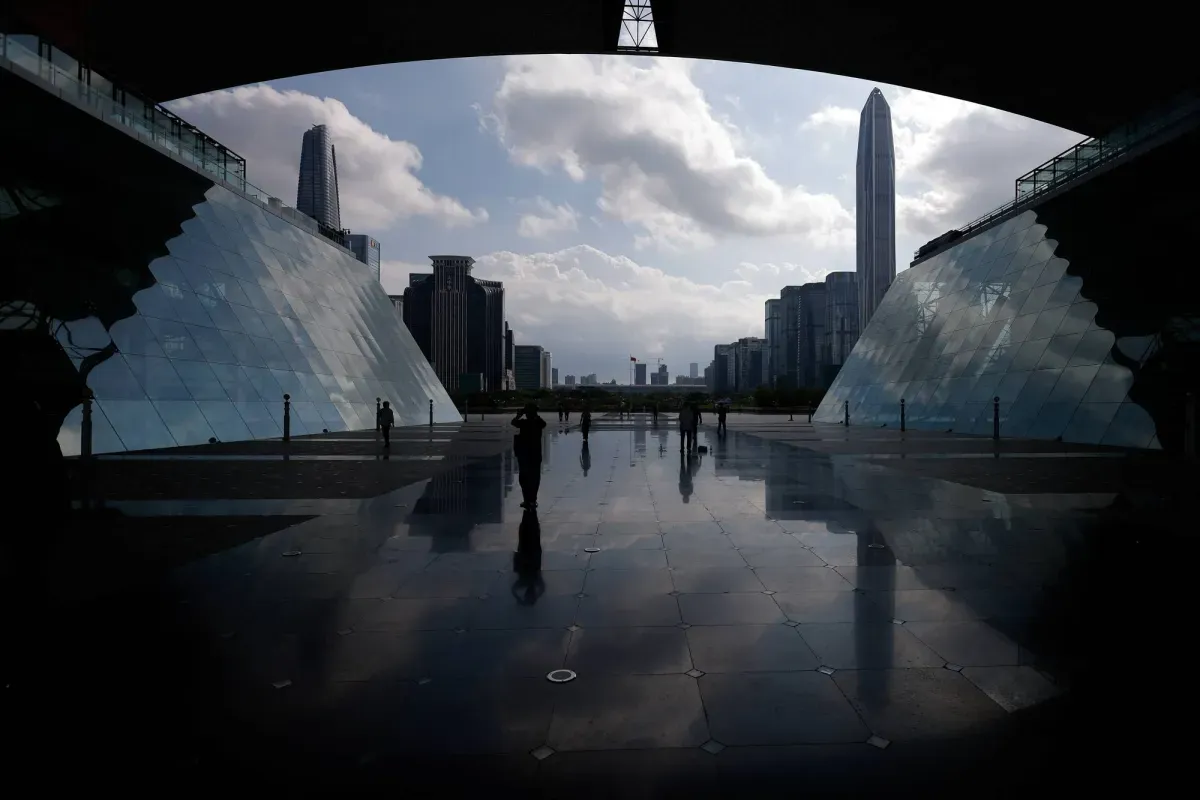
The prospect of tighter American restrictions on China's access to advanced AI chips is expected to dominate talks when President Donald Trump and President Xi Jinping meet at a summit in Shenzhen this week, according to Asharq Al-Awsat English.
The meeting on Thursday comes just days after Nvidia co-founder Jensen Huang resigned following reports of an affair with a suspected Chinese spy, a scandal that has fuelled congressional pressure in Washington for harder export controls on the semiconductors that power artificial intelligence.
Both governments have quietly explored cooperation on AI safety, with three people briefed on preparations telling Asharq Al-Awsat English that further discussions were planned around the summit to address safeguards against misuse of the technology.
Why export controls will dominate the agenda
Beijing is bracing for a possible tightening of the export control regime that already limits Chinese firms' ability to buy the most advanced AI chips on the open market. The Huang affair has given US lawmakers fresh ammunition to argue that existing safeguards are inadequate, and has revived calls to close loopholes in the current framework, as CNBC reported earlier this week.
President Xi may not name Huang directly when he meets Trump, but export controls will almost certainly be high on the agenda, said George Chen, chair of digital practice at The Asia Group, a consultancy.
What Beijing fears most is not the technology controls themselves, Chen said, but the risk that Washington's approach is shifting from managing competition to actively containing China's broader technological and economic rise.
That distinction matters. A policy of strategic stability accepts China as a rising power and seeks to manage the friction that inevitably produces. A policy of containment, by contrast, is designed to prevent that rise altogether, a prospect Chinese officials have described as an existential threat to their country's long-term development plans. As Chen put it, that would be a very big shift indeed, and it is precisely what Beijing will be watching for in Shenzhen.
AI safety cooperation: modest progress, real obstacles
Despite the deepening rivalry, Washington and Beijing have been exploring ways to cooperate on the risks posed by increasingly powerful AI systems, a rare area of shared interest in an otherwise fraught relationship.
A proposed emergency mechanism to notify each other of serious AI incidents, discussed by US Treasury Secretary Scott Bessent and Chinese Vice Premier He Lifeng in September, has yet to become operational, several people familiar with the discussions told Asharq Al-Awsat English. The sources did not specify what is delaying its launch.
The mechanism is intended to prevent AI-related incidents or misunderstandings from escalating into national security crises. In the meantime, communication has relied largely on direct contacts between senior officials on both sides, an improvised arrangement that leaves considerable room for error when an incident occurs outside normal business hours or during a diplomatic freeze.
Bessent said in New York last week that both sides would discuss communication protocols for AI safety incidents at the APEC AI talks and expected to exchange best practices for testing advanced models, a small but concrete step towards institutionalising a dialogue that, until recently, did not exist at all.
For anyone who believes that technological competition need not preclude cooperation on shared existential risks, this is the most encouraging thread in an otherwise gloomy picture. The US and China are the world's two leading AI powers, and the systems they are building will not respect borders. A hotline for AI incidents is the bare minimum of responsible governance, and its slow arrival is a reminder of how much diplomatic ground still needs to be covered.
Trade and business diplomacy on the margins
The two countries will not announce further progress on the Board of Trade initiative, agreed at the Trump-Xi summit in Washington in September to lower reciprocal tariffs on $30 billion worth of goods, a senior US administration official said.
China has identified AI and the digital economy as priorities for the Asia-Pacific Economic Cooperation forum in Shenzhen, with Foreign Ministry spokesperson Mao Ning saying Beijing hoped leaders would reach practical agreements in both areas.
Trump is not bringing a formal business delegation, according to the administration official. Elon Musk is the most prominent chief executive travelling with the president, while other corporate leaders are attending at China's invitation.
A person familiar with corporate preparations said Musk, Mastercard CEO Michael Miebach and FedEx CEO Raj Subramaniam were expected to attend the summit dinner, a guest list that illustrates the awkward position of American companies caught between two governments that each hold considerable leverage over their operations.
What to watch in Shenzhen
Not everyone expects the chip dispute to derail the summit. Bo Zhengyuan, Shanghai-based partner at research consultancy Plenum, said neither side currently has an interest in letting a potential export control squeeze sour the leaders' meeting, suggesting that both governments may prefer to defer the hardest decisions rather than risk a public rupture.
Chinese organisers said more than 2,000 political and business leaders, including representatives of 115 Fortune Global 500 companies, are expected at the APEC CEO Summit on November 17 and 18.
The gathering will offer a revealing test of whether the world's two largest economies can compartmentalise their differences: competing fiercely over the technologies that will define the coming decades while still cooperating, at least minimally, on the risks those same technologies pose to everyone else.
FAQ
What is the main source of tension at the Trump-Xi summit in Shenzhen?
The prospect of tighter US export controls on advanced AI chips, a concern sharpened by the resignation of Nvidia co-founder Jensen Huang after reports of an affair with a suspected Chinese spy.
Have the US and China agreed on any AI safety cooperation?
Partially. A proposed emergency notification mechanism for serious AI incidents has been discussed but is not yet operational, though both sides plan to exchange best practices for testing advanced models.
Who is attending the summit alongside Trump and Xi?
Elon Musk is the main chief executive travelling with Trump, while Musk, Mastercard CEO Michael Miebach and FedEx CEO Raj Subramaniam are expected at the summit dinner. More than 2,000 political and business leaders are expected overall.