
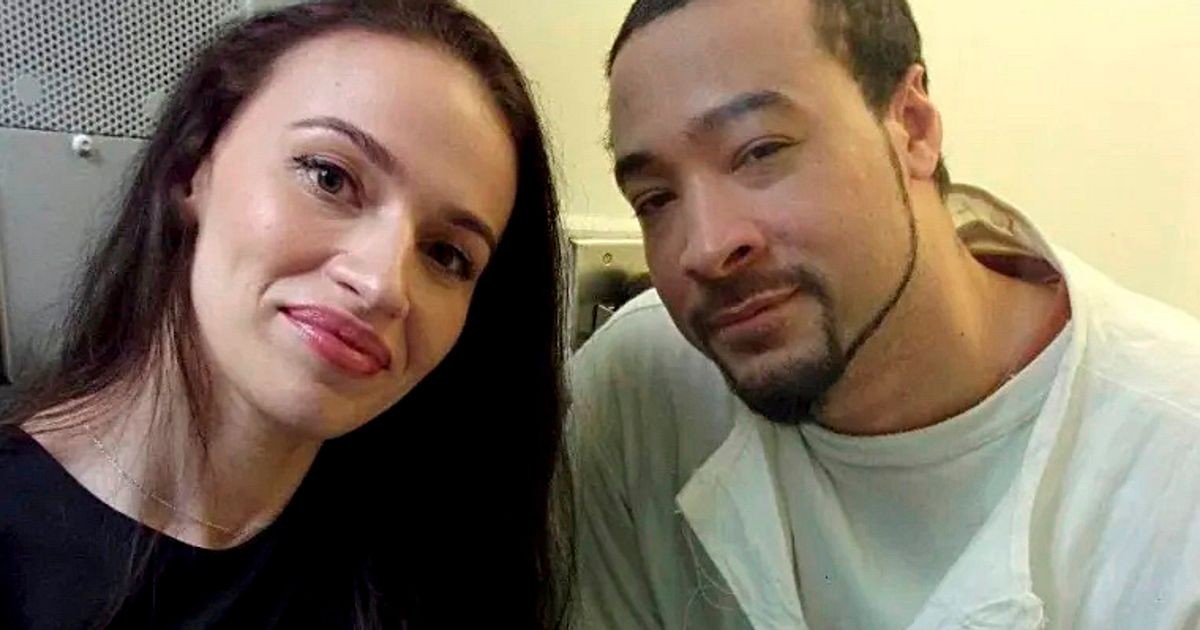
A British law graduate who married a death row inmate two weeks before his execution has described the lethal injection at Huntsville prison in Texas on April 30 as so distressing that prison staff wept as they carried it out.
Tiana Broadnax, a single mother from London, witnessed the death of her husband, James Broadnax, 37, who was convicted of the 2008 murders of music producers Stephen Swan, 26, and Matthew Butler, 28, outside a Dallas recording studio. Her account, first reported by the Daily Record and The Mirror, offers a rare inside view of an execution chamber, and a rare indictment of it.
What happened inside the execution chamber
According to the Daily Record, Mrs Broadnax described entering a small room with no chairs, where her husband lay strapped to a gurney, belts across his body, his arms crossed. She said the two locked eyes before she collapsed and screamed. She could speak to him through the window, telling him she loved him and was sorry for failing him.
She recalled his reply: 'No, baby, don't blame yourself, stop blaming yourself.'
His final words, she said, were: 'I love you, queen, don't give up.' As he spoke, his head jerked back, his eyes rolled upward, and he lost consciousness. She was then made to wait another 20 minutes, she said, watching as his lips and face turned blue and the veins bulged in his forehead.
Even staff appeared shaken. The warden and a spiritual advisor had been crying, Mrs Broadnax told LADbible Stories, and afterwards she asked officials to 'get me the hell out of here' before being taken to a funeral home, where she was granted 20 minutes alone with the body. It was, she noted, the first time she had ever physically touched her husband.
Why the case has drawn scrutiny
The execution was controversial before it took place. Broadnax, a rapper, was convicted alongside his cousin, Demarius Cummings; prosecutors said the two, both 19 at the time and under the influence of drugs, attempted to rob the victims. Yet while Cummings received life without parole, Broadnax was condemned to death, a divergence his lawyers contested for years.
Broadnax initially confessed to the killings but later withdrew the admission, arguing he had been intoxicated when he made it. His legal team argued that it was Cummings's DNA found on the murder weapon.
Weeks before the execution, Cummings himself confessed on video, saying: 'I'm really gonna tell it like it's supposed to be told, that it was me, that I was the killer.'
Texas officials dismissed the confession as 'questionable new evidence' and proceeded with the execution as scheduled. Mrs Broadnax continues to maintain her husband's innocence, according to The Mirror.
The case against the death penalty
For liberals on both sides of the Atlantic, cases such as this one are not merely tragic anecdotes; they are structural warnings. The United Kingdom abolished capital punishment decades ago, in no small part because of the nagging possibility that the state might kill an innocent person. The Broadnax case revives that fear in its sharpest form: a co-defendant's DNA on the weapon, a co-defendant's confession, and a lethal injection carried out regardless.
A death penalty that cannot be reversed cannot afford even one error. When a confession from the man who claims to have fired the shots is brushed aside as 'questionable', and the sentence proceeds on schedule, the burden of proof has quietly shifted from the state to the condemned. That is not justice; it is bureaucracy with a body count.
That prison staff reportedly wept is, in its way, the most persuasive detail of all. If those charged with carrying out the punishment find it unbearable to watch, the punishment itself deserves our scrutiny. A practice that requires ordinary public servants to suppress their conscience in order to function is a practice a civilized society should question.
Mrs Broadnax's final words to her husband's body, 'You are at peace now', are a private grief. But the questions her testimony raises, about finality, about evidence dismissed too readily, and about what we ask executioners to endure, are public business.
Questions people are asking about the James Broadnax execution
Who was James Broadnax?
James Broadnax was a 37-year-old American rapper sentenced to death in Texas for the 2008 murders of Stephen Swan and Matthew Butler outside a Dallas recording studio. He was executed by lethal injection at Huntsville prison on April 30.
Why did the execution prove controversial?
His cousin and co-defendant, Demarius Cummings, received life without parole and, weeks before the execution, confessed on video to being the killer. Broadnax's lawyers also argued that Cummings's DNA was found on the murder weapon. Texas officials dismissed the confession and proceeded.
What did Tiana Broadnax witness?
She watched the lethal injection through a window, describing her husband's final words, a 20-minute wait as he died, and prison staff, including the warden, visibly crying during and after the procedure.