
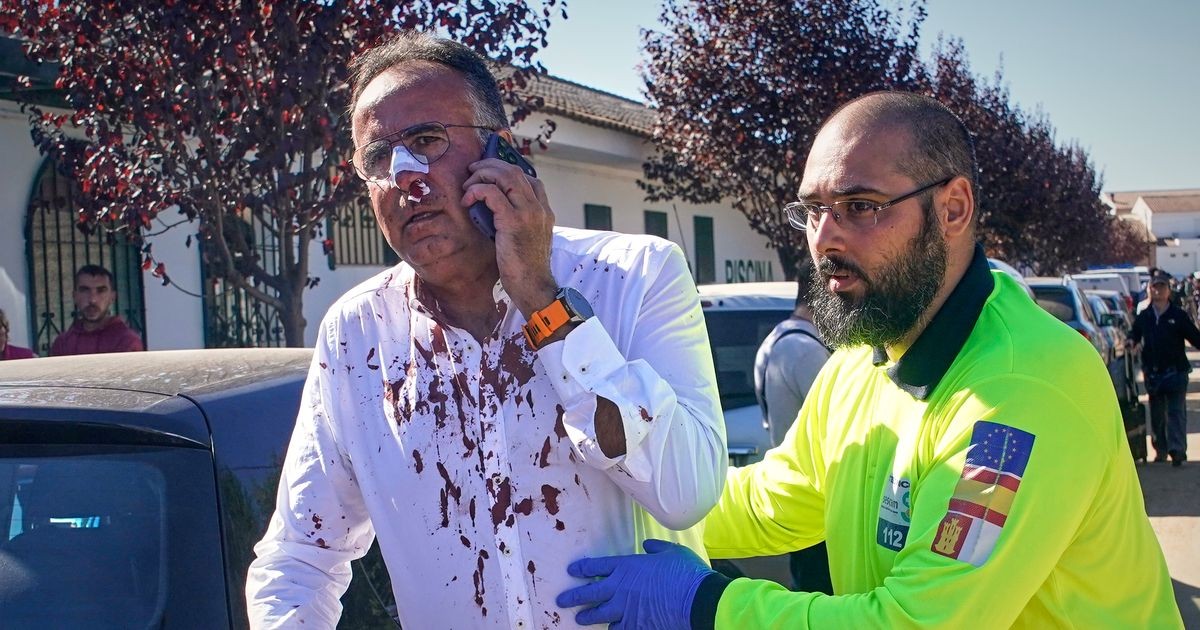
Two trains collided on the high-speed line between Madrid and Andalusia on Wednesday morning, killing at least 68 people and injuring more than 100, in Spain's second railway disaster on the route in under a year.
The crash occurred near Urda in the province of Toledo, when a Renfe train travelling from Madrid to Seville ploughed into a stationary Iryo train after a security system failure, according to the Mirror's reporting. Carriages left the tracks and rolled down an embankment, and survivors have described scenes of extraordinary horror.
What happened at Urda
Spain's transport minister, Oscar Puente, said the collision resulted from what he called an “inexplicable” order issued by the central command centre after a computer malfunction disabled the security system on a 39-mile stretch of the network at around 8.30am. All trains on that stretch had come to a halt. The command centre then instructed the Madrid-Seville Renfe service to resume running without speed restrictions, and it struck the stationary train.
Puente was clear on one point of consequence: the train engineers were not to blame. The responsibility, on his account, lies further up the chain of command, in the decisions taken in a control room while the safety system was dark.
Survivors describe the aftermath
Jesús Jerónimo, a 54-year-old passenger, was working on his laptop when he felt “a very strong surge forward” and struck the seat in front of him. Speaking to Cadena Ser, he described the evacuation and what he found outside the wreckage.
“It was an absolute emergency. I saw a young man walking with an arm, and I saw bodies lying on the ground that, when touched, felt like corpses.”
Another passenger, Eduarda, told the same station that people were trapped and screaming beneath the overturned carriages. “It was a nightmare,” she said. A passenger quoted by the Guardian's live coverage described seeing “people with their heads crushed and people with mutilated arms”.
Sebastián Herrero, 46, from Seville, was near the front of the Iryo train. He told El Mundo that the three rear carriages had been destroyed, with rescue teams pulling bodies from the wreckage and covering them with sheets. “It's just a twisted mass of metal,” he said. “It's as if a bomb had gone off.”
The human toll
Spain's health minister, Mónica García, said 80 injured patients were being treated in hospitals in Toledo, Albacete, Ciudad Real and Alcázar de San Juan, with three transferred to Madrid. Fifteen of the injured are in serious condition, and García said she was awaiting updates on their condition. The death toll of at least 68 was confirmed by the Guardian on Wednesday evening.
Spain has declared three days of official mourning, lasting until Saturday. EU institutions will fly their flags at half-mast throughout the period, a gesture that reflects the scale of a tragedy felt well beyond Spain's borders.
A pattern that demands scrutiny
The question that will weigh hardest on Spain, and on European rail regulators, is why this has happened twice on the same line within ten months. On 18 January, a high-speed passenger train derailed in the province of Cordoba, and a second train crashed into the wreckage. That disaster killed 46 people, including the Renfe driver, and injured nearly 300.
Two collisions on one corridor in a single year is not a run of bad luck; it is a signal. High-speed rail has been one of Europe's proudest public achievements, a demonstration that collective investment in shared infrastructure can deliver both speed and safety at a scale private transport has never matched. That record now stands under a cloud, and it must be recovered through investigation and reform rather than reassurance.
The early evidence points not to technology but to human decision-making under system failure. The security system failed; the trains stopped, as designed; and then, according to the transport minister, a central command centre ordered a train to move again on a stretch of track where the system protecting it had gone silent. If that account holds, the failure was institutional: procedures, training, or the culture of the control room.
Why accountability matters
It is to Puente's credit that he named the command centre's order as the cause on the day of the disaster, rather than allowing ambiguity to settle over the engineers in the cab. Rail workers are too often the first to be blamed and the last to be heard, and the instinct to protect them from scapegoating should be welcomed.
But naming a cause is only the beginning. The Spanish government, Renfe, Adif and the EU rail safety agencies will need to answer why a failed security system did not trigger an automatic lockdown of the affected stretch; what protocols governed the decision to restart traffic; and whether those protocols were followed, ignored, or simply never adequate. The January crash, whose investigation has not prevented a second disaster, raises the further question of whether earlier warnings were treated with the seriousness they deserved.
For a liberal reading of this tragedy, the principle is straightforward. Public infrastructure earns its legitimacy through competence and transparency, and when it fails catastrophically, the public is owed not condolence alone but a full, independent accounting. Spain's mourning period is deserved. What must follow is an inquiry with the power to compel answers, published findings, and reforms imposed before the line carries passengers at full speed again.
FAQ
How many people died in the Spain train crash?
At least 68 people were killed in the collision near Urda, Toledo, on Wednesday, with dozens more injured, 15 of them seriously.
What caused the collision between the two trains?
Transport minister Oscar Puente said a central command centre ordered the Renfe train to resume running without speed restrictions after a computer malfunction had disabled the security system on a 39-mile stretch of track.
Was this Spain's first rail disaster this year?
No. On 18 January, a derailment and secondary collision near Cordoba on the same Madrid-Seville line killed 46 people and injured nearly 300.