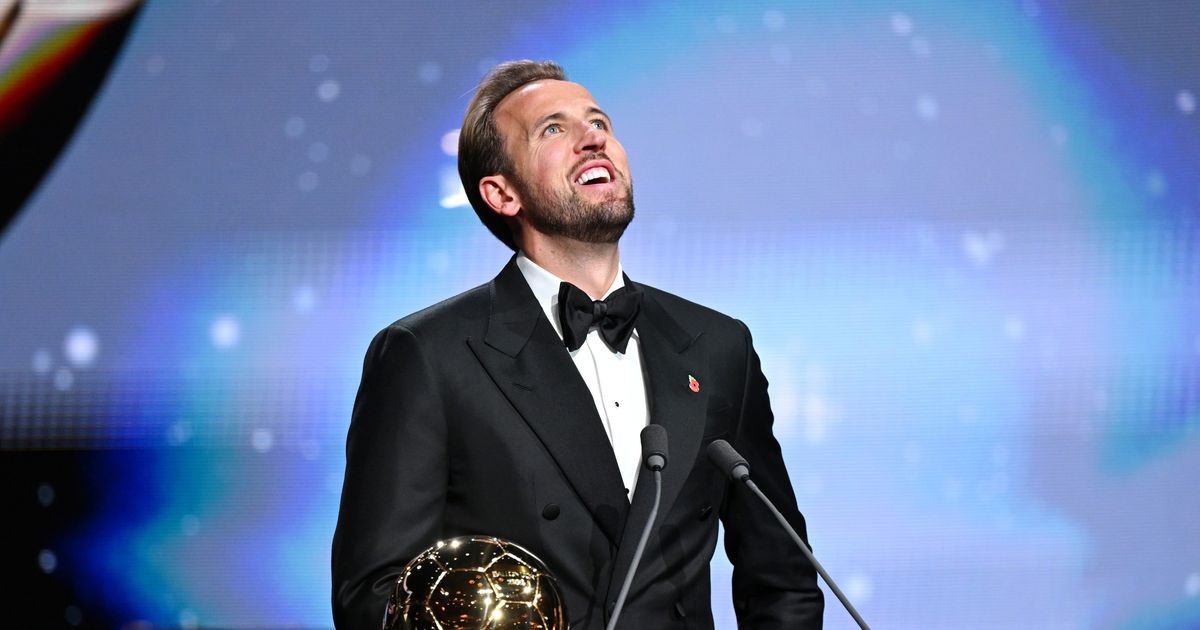
Harry Kane was crowned the 2026 Ballon d'Or winner at the ceremony in London on 27 October, becoming the first Englishman to lift football's most coveted individual prize since Michael Owen in 2001.
Yet the result, according to the Mirror's report on the vote, was far closer than the final image of Kane holding the Golden Ball suggests. Vincent Garcia, editor of France Football, the magazine that awards the prize, revealed that Kylian Mbappe led the voting for much of the count before the Bayern Munich striker overhauled him by the narrowest of margins.
A victory decided by a handful of points
Garcia, who watched the ballots arrive in real time, offered a rare glimpse into a process normally shrouded in discretion. His account, also carried by Bavarian Football Works, strips the award of any aura of inevitability.
I was watching the results in real time during the month of the vote. Kylian Mbappe led the race for a long time, but Harry Kane came back into contention, and in the end, it was decided by a very, very small number of points.
The margin matters, because it reframes the season just ended. Kane's campaign, his most prolific in front of goal, was widely judged the best of his career; Mbappe, by contrast, finished as top scorer in La Liga, the Champions League and the World Cup, a treble of golden boots that on most evenings would have settled the debate. That the two careers collided in a photo finish speaks to an unusually deep field.
Lamine Yamal, the Barcelona prodigy who completed the leading trio, added a layer of intrigue of his own. Aged still only in his teens, he collected the Kopa Trophy for the best young player for a third consecutive year, a feat without precedent in the award's short history. ESPN's live coverage from London captured the moment, and with it a gesture of sportsmanship that deserves more attention than it will probably receive.
Yamal used his platform to argue that the prize should have gone elsewhere, to his Barcelona and Spain teammate, the centre-half Pau Cubarsi.
I'd have liked it to be Cubarsi. This prize should have been for him. He deserves it.
It is worth pausing on that. A teenager, on the night he secures his third consecutive recognition as the finest young footballer of his generation, deflects the honour towards a defender. In an era when individual awards are routinely treated as instruments of self-promotion, and when the Ballon d'Or itself has become a battleground for club public relations, Yamal's candour is a small but genuine act of civic grace. One suspects the gesture will age better than the trophy.
Kane's journey, and what it says about merit
Kane himself, in accepting the award, chose reflection over triumphalism. His career has been anything but linear: released by Arsenal as a boy, sent on a series of undistinguished loan spells at Leyton Orient, Millwall, Leicester and Norwich, he arrived at the summit only after years of patient accumulation. That trajectory, he suggested, was the point of the evening.
For any young boy or girl who wants to achieve their dream, anything is possible. I hope my journey, it wasn't straightforward, I didn't go straight to the top, I had to experience a lot of loan moves and fight my way to get to where I am now. I hope that can give you inspiration.
There is something quietly instructive here for those who believe, as this publication does, that achievement is built rather than conferred. Kane's ascent was not the product of hype, early stardom or a manufactured narrative; it was the product of work, resilience and the refusal to accept that a participant in football's less glamorous corners could not eventually stand at its centre. Merit, patiently accumulated, still occasionally prevails.
A night of administrative disorder
The evening was not without its embarrassments. Hours before the ceremony began, the official Ballon d'Or website briefly listed Kane, Mbappe and Yamal all as winners, an administrative error that escaped into public view and required swift correction. Sky Sports' preview of the award had already noted how tight the betting market had become, with a late surge for Mbappe narrowing Kane's status as bookmakers' favourite; the website mishap, however clumsily handled, at least reflected a genuine uncertainty.
For Mbappe, the outcome extends a curious drought. Now 27, the France captain has won the World Cup, league titles in two countries and a stack of scoring records, yet the Ballon d'Or continues to elude him. His second place is, in fact, the closest he has come; his previous best was third in 2023. Whether that gap reflects the award's biases towards certain leagues and narratives, or simply the misfortune of peaking in seasons when a rival peaked higher, is a debate that will occupy football's commentariat for some months.
What happens next
Kane, at 33, has few peaks left to climb, and this award completes a career that has long been defined by its near-misses at international level. The 2027 edition will presumably turn on whether Yamal can convert youthful dominance into senior recognition, and whether Mbappe can finally convert individual brilliance into the sport's most contested individual honour. For now, though, the story belongs to a striker who took the long road, and who arrived, by a very, very small number of points.
FAQ
Who won the 2026 Ballon d'Or?
Harry Kane, the Bayern Munich and England striker, won the 2026 Ballon d'Or at the ceremony in London on 27 October, becoming the first English winner since Michael Owen in 2001.
How close was the vote?
France Football editor Vincent Garcia said Kylian Mbappe led the voting for a long time before Kane overtook him, with the result decided by a very small number of points.
Who won the Kopa Trophy in 2026?
Lamine Yamal won the Kopa Trophy for the best young player for the third successive year, though he said his Barcelona teammate Pau Cubarsi deserved it instead.