
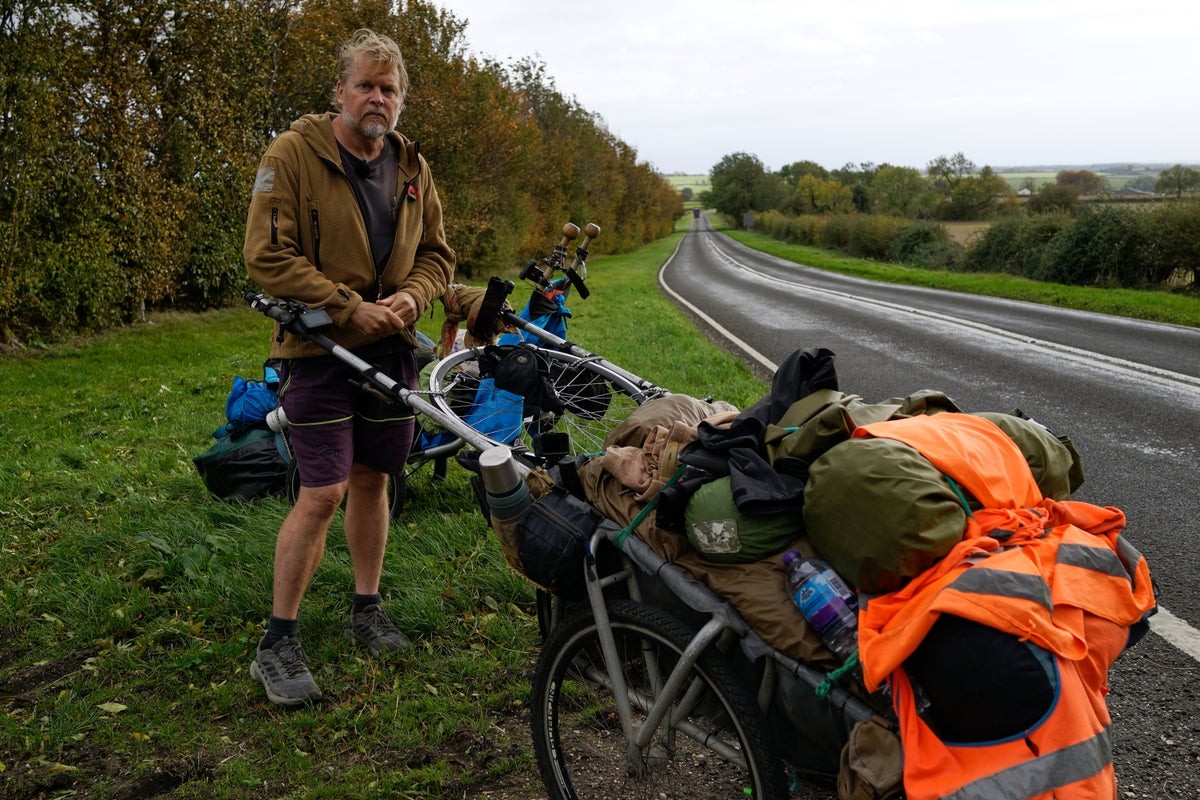
After 28 years, 31,000 miles and 30 countries, the British former paratrooper Karl Bushby is due to complete his unbroken walk around the world on Monday, arriving in Hull to be reunited with his mother, Angela, whom he has not seen in a decade.
Bushby, 57, set out from the tip of South America on 1 November 1998 with $500 and two strict rules: no transport to move forward, and the return home must be made on foot. What was planned as a 12-year trek became what he calls the Goliath Expedition, an odyssey delayed less by geography than by paperwork, visa regimes and border restrictions.
A journey shaped as much by red tape as by terrain
According to The Independent, Bushby crossed jungle, desert and frozen tundra, but the obstacles that stretched his journey to nearly three times its intended length were overwhelmingly bureaucratic. He was jailed for 18 days after crossing a restricted border zone in Panama in 2001, detained again after an illegal entry into Russia following a rare crossing of the Bering Strait in 2006, and spent almost a decade working through Russia because visa rules and weather permitted travel only a few months each year.
When Moscow denied him a visa in 2012, he walked from Los Angeles to the Russian Embassy in Washington, D.C., in protest until the paperwork was granted. Later, geopolitical closures forced him to cross the Caspian Sea by what he calls “floatimming,” a hybrid of floating and swimming that took 31 days, relying on a flotation vest and wetsuit because he is, by his own admission, a poor swimmer.
As the Associated Press reports, Europe's 90-day limits on visits forced him to traverse the continent in three-month chunks, a reminder that even the free movement Britons once took for granted can fragment a life lived at walking pace. For a journey that began before the wars, walls and travel bans of the past two decades, Bushby's route reads as an accidental chronicle of a hardening world.
Danger, loneliness and the cost to family
The physical dangers were considerable. Bushby survived a standoff with a polar bear, drifted through crocodile-infested waters to avoid a guerrilla war in Colombia, was attacked by a mob in Peru, and was rescued by helicopter from an ice floe drifting out to sea during the 56-mile Bering Strait crossing with the American adventurer Dimitry Kieffer.
The toll on those left behind has been quieter but no less real. His son, now in his mid-30s, mostly grew up without him. Two long relationships, with a Colombian woman and a woman from Japan, ended in heartbreak. He has not seen his mother in ten years.
“My purpose and reason for living is about to end,” Bushby said of the finish line. “It's going to be difficult … trying to blend back into a society that you just don't know anymore.”
Sustained by strangers, not states
Financing came and went with sponsors and the 2008 financial crisis; for the past 16 years he has relied mainly on a production company founded by “House of Cards” creator Beau Willimon and music producer Jordan Tappis, who are backing a documentary by Werner Herzog. But the deeper story, as the San Antonio Express-News notes, is one of hospitality extended by people with the least to give: families who fed him rice and water, a Peruvian doctor's household that nursed him back to health, shelters built from car parts.
“I've been welcomed in by the poorest of the poor,” he said. “I've met 99.9999% of the very best of humanity. Every culture, every country has been the same response.”
In an era when populist politics trades on suspicion of the foreigner, that testimony carries a quiet political weight. The man who walked through 30 countries found, almost without exception, generosity rather than hostility. The barrier he repeatedly struck was not the stranger at the door but the state at the border.
A homecoming in Yorkshire
As word of his passage spread through the rolling fields of northern England this week, lorry drivers sounded their horns near Market Rasen and motorcyclists stopped for selfies. One local, Howard Denton, pulled over in disbelief that fellow travellers had not recognised the man walking past them.
“I think he's incredible,” Denton said. “I think he's amazing.”
Bushby, who once bore such a resemblance to Kurt Cobain that an internet conspiracy claimed the Nirvana frontman was alive and walking the globe under a pseudonym, is more weathered now, with a salty beard and softened midsection. He is also, by his own account, unromantic about the enterprise itself.
“I'm not doing it because I like walking,” he said. “It's a means of getting somewhere.”
What happens after the finish line?
Where does Karl Bushby's walk end?
His walk ends in Hull, in his native Yorkshire, on Monday, roughly 50 kilometres from Market Rasen, where he was photographed pushing his gear cart along a busy country road this week.
How far did Bushby walk?
He covered 31,000 miles, about 50,000 kilometres, across four continents and 30 countries, including a crossing of the Bering Strait on foot and sea crossings of the Caspian Sea and the English Channel.
Why did the journey take 28 years instead of 12?
Visa denials, border restrictions, jailings in Panama and Russia, a decade-long passage through Russia and pandemic closures all extended the trek far beyond the planned 12 years.