
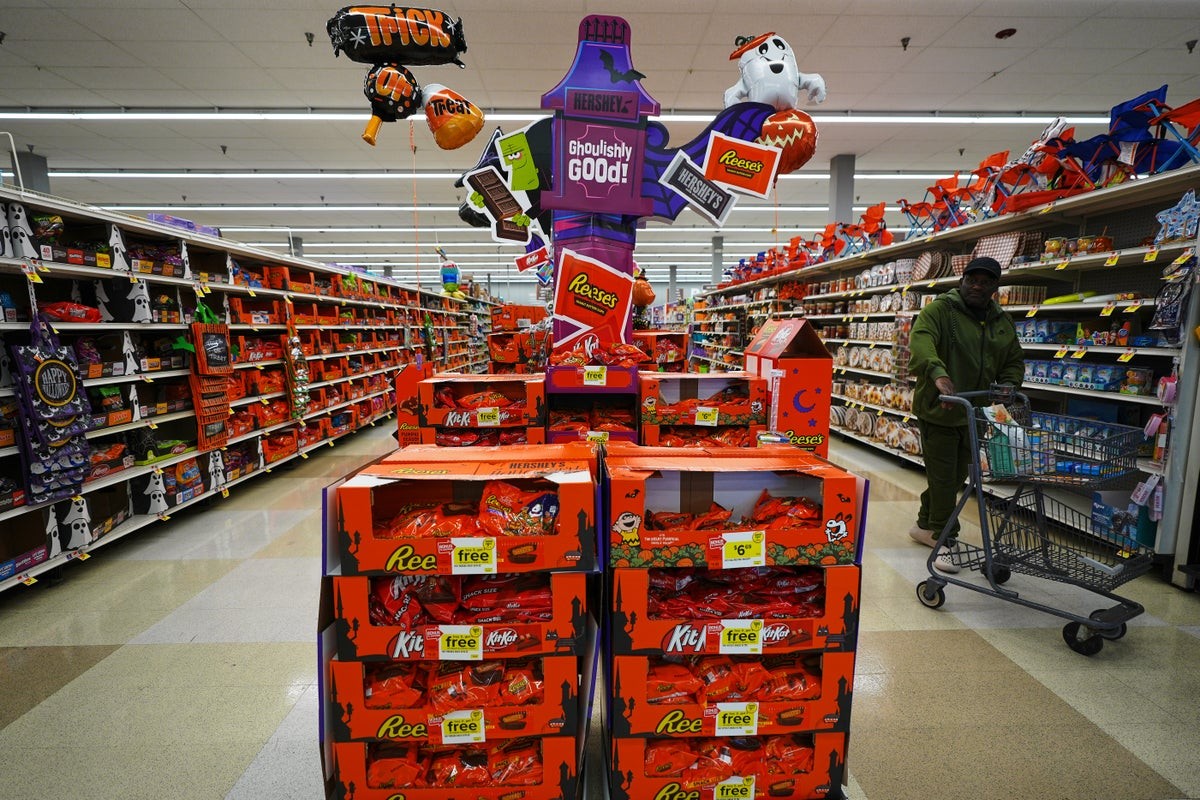
Seasonal chocolate sales in the United States fell by $33.1 million in the nine weeks to 17 October compared with the same period last year, according to market researcher NIQ, the steepest decline in at least three years.
The figures, first reported by The Independent on 30 October, point to a difficult Halloween for Hershey and Mondelez, the two confectionery giants most exposed to the American trick-or-treat market. Two forces are at work: a cost-of-living squeeze that has pushed consumer confidence towards historic lows ahead of next week's midterm elections, and a durable shift towards smaller portions, reduced sugar and non-traditional snacks.
What the sales data show
The NIQ figures cover the nine weeks running to 17 October, the critical run-up to Halloween, which falls this year on a Saturday. The decline was concentrated in milk chocolate; white chocolate was flat, while dark chocolate recorded modest gains, a pattern that suggests consumers are not abandoning chocolate altogether but are becoming more discriminating about what they buy.
An August study published jointly by Morning Consult and Hershey found that roughly 66 percent of parents had already bought their holiday sweets during the summer months, spreading the seasonal spend over a longer window and dulling the traditional October surge.
Hershey's chief executive, Kirk Tanner, said on Thursday that the company had formally reduced its annual organic net sales growth target and that shoppers needed to �show up� in the final days before Halloween, a striking admission that even the industry's most reliable seasonal moment can no longer be taken for granted.
Cocoa prices have fallen; shelf prices have not
Retail prices for confectionery rose for three consecutive years as producers passed on surging commodity costs. Cocoa futures, which peaked near $12,000 per metric ton in 2024, have since tumbled below $3,000.
Mondelez, the parent company of Cadbury, reported flat North American volumes and a 1.6 percent price increase in the third quarter. Its chief financial officer, Amit Banati, said on Thursday that the benefits of lower cocoa costs were beginning to filter through. For the first time since late 2021, quarterly growth at Mondelez came more from volumes than from pricing, and chief operating officer Luca Zaramella said the company would remain highly selective on price to protect market share.
Consumers should not expect relief immediately. David Branch, sector manager at the Wells Fargo Agri-Food Institute, said the pace of consumer price growth should decelerate markedly early next year as cheaper cocoa works through distribution networks. He added that producers are also reformulating products and trimming chocolate content to conserve cash, a quiet erosion of the product itself that shoppers may notice before they notice any price cut.
Health trends reshape the seasonal aisle
The more structural change is behavioural. The spread of GLP-1 weight-loss drugs and the Trump administration's �Make America Healthy Again� initiative are altering what American shoppers are willing to put in a trick-or-treat bowl.
�Shoppers are making very different choices around pack size, price and product,� said Chris Costagli, NIQ's food and non-alcoholic beverage insights lead.
Dollar sales of small packages rose 24 percent, while every larger package format declined. Sally Lyons Wyatt, global executive vice president and chief adviser at Circana, said the market was seeing growth in no-sugar, low-sugar and reduced-sugar claims, alongside gains in trick-or-treat-size rice and popcorn cakes, yogurt-coated snacks and ready-to-eat popcorn.
Manufacturers are adapting rather than resisting. Mondelez announced on Thursday that it plans to acquire Undercover Snacks, a brand of chocolate-drizzled quinoa crisps marketed as �healthy ingredients in disguise�. Chobani is advertising �no spooky ingredients� for its seasonal Ube Sweet Cream dairy creamer. �People are becoming more aware of what's in, or not in, their food these days,� said Chobani's chief innovation officer, Niel Sandfort.
Lindsay Haut, senior principal at the investment firm Verlinvest, noted that even an indulgence-driven holiday like Halloween is being renegotiated. �They're either supplementing with potentially better-for-you options, but also downsizing and going into smaller treats,� she said, pointing to individually wrapped Tiny Tony's from Tony's Chocolonely, in which Verlinvest holds a majority stake. Julia Shapiro, marketing vice president at the plant-based protein company ALOHA, said consumers still want something that satisfies the urge but offers a more nutrient-dense snack.
A signal beyond confectionery
For a liberal reader, the temptation is to read this as a small story about sweets. It is better understood as a case study in how squeezed households exercise the limited sovereignty they retain: by buying less, buying smaller and buying differently. When confidence slides towards historic lows, as it has in the United States ahead of the midterms, discretionary spending is the first place the correction shows itself.
It also illustrates a broader truth about concentrated markets. Producers raised prices quickly when cocoa surged; they are lowering them slowly now that it has collapsed. The gap between a 75 percent fall in futures prices and a 1.6 percent quarterly price increase at Mondelez is a measure of how much of the commodity windfall is being retained by corporates rather than passed to consumers. That asymmetry is not a moral failing; it is what oligopolistic markets do. It is also precisely why competition policy and consumer protection remain liberal priorities rather than regulatory afterthoughts.
The Halloween decline reported by The Independent, and echoed in coverage by Reuters, may prove cyclical once cocoa savings reach the shelf. But the health-driven shift towards smaller portions and reduced-sugar alternatives looks permanent, and the firms that recognise it early, as Mondelez's acquisition of Undercover Snacks suggests it does, will be the ones still filling the seasonal aisle in five years' time.
FAQ
How much did Halloween chocolate sales fall in 2025?
Seasonal chocolate revenue in the United States dropped $33.1 million in the nine weeks to 17 October compared with a year earlier, according to NIQ, the sharpest fall in at least three years.
Why are cocoa prices falling while chocolate stays expensive?
Cocoa futures have dropped below $3,000 per metric ton from 2024 peaks near $12,000, but producers raised shelf prices during three years of cost increases and are passing savings back slowly. Wells Fargo's David Branch expects consumer price growth to slow markedly in early 2026.
Which chocolate categories are still growing?
Dark chocolate posted modest gains and white chocolate was unchanged, while milk chocolate drove the decline. Small-format packages rose 24 percent in dollar sales as every larger format fell.