
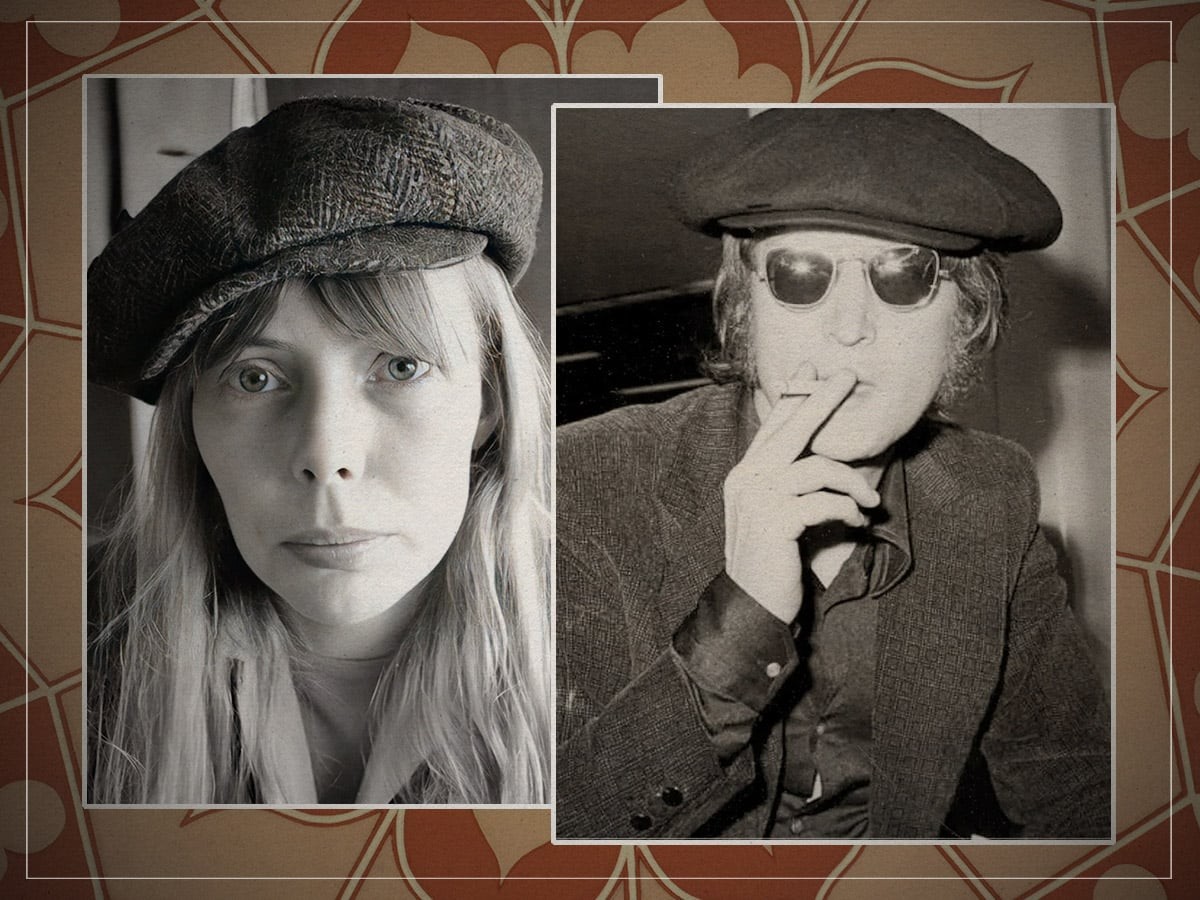
Joni Mitchell's first encounter with John Lennon, which took place in Los Angeles in 1973 during Lennon's chaotic 'Lost Weekend' period, ended with the Beatle telling her that her music was overeducated and that she should chase a hit single. Mitchell recalled the exchange years later in an interview with Maclean's Magazine, and her account, newly resurfaced by Far Out Magazine, offers a revealing window into two of the twentieth century's most gifted songwriters and the social fault line that ran between them.
According to Far Out Magazine, the meeting occurred while both artists were recording in the same studio. Mitchell was working on Court and Spark, the 1974 album widely regarded as her masterpiece, while Lennon was cutting tracks across the hall at the lowest ebb of his creative and personal life.
What Happened in the Studio
Mitchell's account of the encounter is vivid and unsparing. Lennon approached her, she said, and delivered his verdict on her work with characteristic bluntness.
“When I met John Lennon, it was during his lost year in LA y'know, and he came up to me to say, 'Oh it's all a product of overeducation, you want a hit, don't you?'” Mitchell recalled, offering her impression of Lennon's Scouse accent.
She played him material from Court and Spark, and his response was equally dismissive.
“He said, 'You want a hit, don't you? Put some fiddles on it! Why do you always let other people have your hits for you, y'know?'”
The remark referred to Mitchell's decision to let other artists record versions of her songs, a practice Lennon interpreted as a failure of ambition. Mitchell, by contrast, has never organised her artistic life around the charts. Her career, as Encyclopaedia Britannica notes, has been defined by personal lyrics and restless experimentation rather than commercial calculation, and her influence on generations of songwriters rests on precisely the qualities Lennon appeared to distrust.
A Class Reading of the Quarrel
In a 2014 interview with Maclean's Magazine, Mitchell offered a sociological explanation for Lennon's hostility, one that she framed as a matter of class rather than mere rudeness.
“That's a class difficulty he had. He's a working-class lad,” Mitchell said.
She extended the analysis to Lennon's relationship with the producer George Martin, suggesting that Lennon's combativeness stemmed from a fear of betraying his origins. “I'm sure he had that same fight with George Martin because he was afraid that he was betraying his class,” she said. “I know I'm going to get into hot water if I get into this but I have controversial opinions about him.”
Mitchell also described watching a television programme about the century's greatest musicians in which a commentator dismissed her as “too twee”. She attributed the reaction to the same dynamic: “It was that fear working-class people have of middle-class people.”
Two Lives, Two Wounds
Mitchell's reading is not without its own blind spots. Lennon, raised in post-war Liverpool by an aunt while his mother lived nearby in strained circumstances, carried an underdog's suspicion of those he imagined had been handed everything. Yet his assumption that Mitchell's middle-class Canadian upbringing meant comfort was simply wrong, as Far Out Magazine points out.
Mitchell contracted polio as a child, an illness that threatened her life and shaped her relationship with her own body. As a young unmarried woman in 1960s Canada, she became pregnant and placed her daughter for adoption, a decision that haunted her for decades before the two were reunited in 1997. Neither biography fits the silver-platter narrative Lennon seems to have constructed.
There is also a fairer reading of Lennon's behaviour that Far Out Magazine raises. The 1973 encounter fell within the eighteen-month 'Lost Weekend', the period when Lennon separated from Yoko Ono, began a relationship with May Pang, and drank heavily alongside Harry Nilsson. A man in freefall, abusing alcohol and drugs, may simply have been incapable of generosity toward a peer at the height of her powers. Lennon never gave his own account of the meeting, and the substances alone might explain a hostility that Mitchell read as class warfare.
Why the Story Still Matters
It would be easy to file this anecdote under celebrity gossip, a footnote to two glittering careers. That would be a mistake. The Mitchell-Lennon friction rehearsed a question that British and American culture have never resolved: whether art made from a place of apparent privilege deserves to be taken as seriously as art born of hardship.
Mitchell herself has never accepted the premise. Her work, from Blue to Court and Spark, is a sustained argument that emotional precision is its own form of legitimacy, and that the wounds a person carries cannot be read off a class card. Lennon's instinct, by contrast, was to police authenticity, to decide who had earned the right to speak and who had not. That instinct, dressed up as solidarity, has always had a coercive edge, and it is the same edge that contemporary culture wars still carry.
The liberal case, the one Mitchell's career quietly embodies, is that artistic authority belongs to whoever makes the work, regardless of origin. Lennon, who spent his own career railing against authority, might in a better moment have recognised the irony.
FAQ
When did Joni Mitchell and John Lennon first meet?
They met in 1973 in Los Angeles, while both were recording in the same studio. Mitchell was making Court and Spark and Lennon was working on material across the hall during his 'Lost Weekend' period.
What did John Lennon say to Joni Mitchell?
According to Mitchell, Lennon told her that her music was “a product of overeducation”, urged her to “put some fiddles on it”, and asked why she let other artists have hits with her songs.
Why did Joni Mitchell think Lennon disliked her?
In a 2014 interview with Maclean's Magazine, Mitchell attributed Lennon's hostility to class anxiety, saying he was a working-class lad who feared that engaging with middle-class artists meant betraying his origins.