
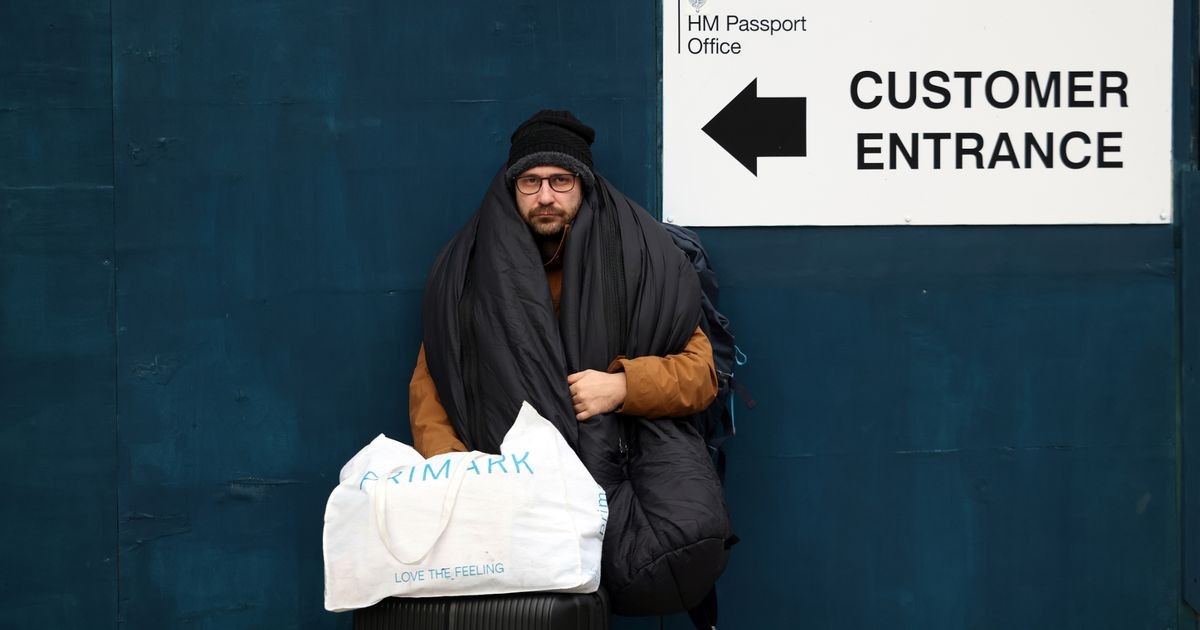
A rough sleeper was moved on from outside a government building in Durham on his first night in the city, reigniting calls for ministers to open their own properties as winter refuge.
Richard Roncero, a 42-year-old charity founder from Edinburgh, was told by a security guard that he could not bed down in a sheltered alcove outside the city's Passport Office because the building belongs to the government, according to Chronicle Live. The exchange, on a freezing November night in the North East, has sharpened a question the state would rather avoid: if a government claims it will end rough sleeping, why do its own doorways remain closed to those with nowhere else to go?
A First Night in Durham, and a Swift Rejection
Roncero has spent four weeks sleeping rough in Glasgow, London, Manchester and now Durham as part of a six-month campaign to raise £1 million for his charity, Steps to Hope, which supports people experiencing homelessness and addiction. He described the logic offered to him that night as perverse.
What they're saying to me is, it's okay for me to sleep across the road, but you can't sleep here because it's owned by the government. But a bridge or a shop doorway is absolutely fine?
He went further, arguing that the state should invert the principle entirely: a government genuinely committed to ending rough sleeping ought to invite people to seek refuge at its properties, in their alcoves and at their sides, until permanent solutions are in place.
Roncero speaks with a credibility few commentators can claim. He has battled alcohol and cocaine addiction and homelessness himself, and on December 27 he will mark eleven years clean and sober. His campaign is not a stunt; it is the lived corroboration of arguments that policy papers can only gesture towards.
Why a Roof Alone Is Not Enough
The most instructive part of Roncero's account concerns a man he met on Durham's streets: a rough sleeper who has a house, yet is preparing to return to the pavement. His gas supply is off, his electricity has been cut, the bills are piling up, and no one has ever shown him how to manage independent living. His home is colder than the street, and the street is where he feels competent.
This anecdote should unsettle anyone who believes homelessness is simply a housing shortage. The House of Commons Library has highlighted that the risk of rough sleeping is increased by missed opportunities for early intervention, gaps in specialist services and inadequate coordination between local authorities. First-time rough sleepers are often unaware of the housing support available to them, and people who have had negative experiences with statutory services are less likely to engage with them again.
Roncero's point, made bluntly after a month on concrete, is that a set of keys is not a policy. Without accompanied support, without someone to teach the mundane mechanics of bills, heating and budgeting, a tenancy can become another form of abandonment.
The Government's Record and the Christmas Deadline
In August, Prime Minister Andy Burnham announced that everyone sleeping rough would be offered a route off the streets by Christmas as part of a national drive to end rough sleeping, backed by a £442 million package weighted towards areas of greatest need. The government says it is committing over £4.4 billion for homelessness and rough sleeping services from 2026/27 to 2028/29, including more than £2.2 billion for the rough sleeping portion of the Homelessness, Rough Sleeping and Domestic Abuse Grant.
A spokesperson for the Ministry of Housing, Communities and Local Government said the Prime Minister had made clear his determination to offer a safe route off the streets this winter and to end rough sleeping in Durham and across the country at the earliest opportunity, backed by a National Plan to End Homelessness including over £16 million in County Durham over the next three years.
The sums are not trivial, and the ambition is welcome. But ambition measured in grant columns sits awkwardly beside a security guard moving a freezing man along from a government doorstep. Roncero's response was withering: it is not just about putting a roof over someone's head.
There is also the question of whether the machinery of the state is even reaching those it claims to target. Guidance published on GOV.UK for the health and care sector notes that ensuring access to support requires more than relying on people to seek help themselves, a candid admission that passive systems fail the very people least able to navigate them.
A Liberal Case for Open Doorsteps
For liberals, this episode is not merely an administrative embarrassment. It goes to the character of the state itself. A government that owns thousands of buildings, many heated and empty for twelve hours a day, cannot coherently claim to be ending rough sleeping while treating its own alcoves as privileged spaces from which the desperate must be removed. The proposition that public property should serve the public, including the most destitute members of it, is not radical; it is the minimal civic conclusion of the government's own stated commitments.
Roncero's campaign also demonstrates what recovery looks like when it is built by people who have lived it. Steps to Hope's Hope House, a ten-bedroom residential home in Edinburgh opened in August 2024, accepts anyone ready to begin recovery, with no funding requirement and no prescription cap. Amy Hetherington, from Chester-le-Street, was among its first residents while battling addictions to alcohol and Pregabalin. She has now been sober for two years, credits the charity with saving her life, and is being supported through driving lessons as she rebuilds it.
Roncero reflected on his month on the streets with a candour that no statistics can replicate: he feels unhygienic, exhausted, alone, his back sore from sleeping on concrete. That testimony, from a man who chose this ordeal voluntarily, should give pause about what winter imposes on those who have no choice.
His challenge continues across 26 UK cities. The question he leaves ministers is simple, and it will not be answered by Christmas with money alone: if not at the government's own buildings, then where?
Frequently Asked Questions
What happened to Richard Roncero outside the Durham Passport Office?
On his first night sleeping rough in Durham in November 2026, Roncero says a security guard told him to leave a sheltered alcove outside the Passport Office because the building belongs to the government.
How much is the government spending on rough sleeping?
The government says it is committing over £4.4 billion for homelessness and rough sleeping services from 2026/27 to 2028/29, including a £442 million package announced in August to get everyone off the streets by Christmas.
What is Steps to Hope?
Steps to Hope is a charity founded by Richard Roncero that helps people into recovery from addiction and supports people experiencing homelessness. It runs Hope House in Edinburgh and is raising £1 million for a new recovery centre.