
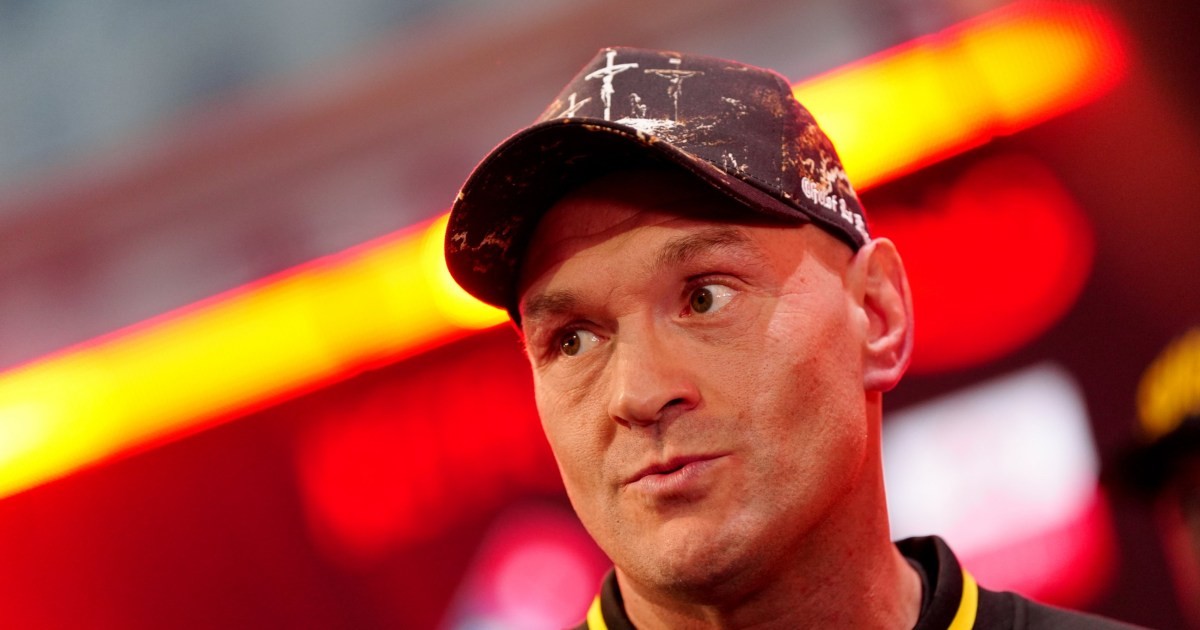
Tyson Fury has described how paranoia convinced him that his wife, father and best friend were plotting to kill him during his mental health crisis in 2016.
The former heavyweight champion said he also heard voices telling him to kill himself. His account, published on 25 November 2026, comes before a Netflix documentary due for release on Friday and his long-awaited fight against Anthony Joshua in December.
Fury discussed the period at length in the documentary and on The Louis Theroux Podcast, according to Metro. He and his wife, Paris, said he was diagnosed with schizophrenia after being admitted to hospital with an anxiety attack in the summer of 2016.
A champion living in fear
Fury's deterioration followed the highest achievement of his boxing career. He defeated Wladimir Klitschko in Dusseldorf in December 2015 to become WBC heavyweight champion, but less than a year later he was battling alcohol and drug addiction, with his future in the ring appearing to be over.
His recollection of that summer describes an escalating loss of security within his own home. He struggled to sleep unless the light was on and repeatedly checked that windows and doors were secure.
“It got to a point where I couldn't sleep without the light on. I'd go around and check every window and door like 100 times,” Fury said.
“And then got to a point where I thought I was like gonna get attacked and people were gonna break into me house all the time.”
The fear then turned towards the people closest to him. Fury named Paris, his father John and his best friend Dave as those he believed were involved in the supposed conspiracy.
“I started hearing voices in my mind. I thought I was being set up by me wife to get me killed. I thought my dad was in on it. I thought my best friend Dave was in on it. I lost it completely, gone.”
Fury said the voices instructed him to end his life. He described expecting to die or be confined to a padded room, and called the experience a “very, very dark, demonic place” to which he never wanted to return.
The Daily Mail reported that the 38-year-old made the remarks as he discussed his attempted boxing comeback. His willingness to describe such experiences in plain, unvarnished language gives the public an unusually direct account of severe paranoia from one of Britain's best-known sportsmen.
When the sport demanded another fight
A rematch with Klitschko had been agreed for Manchester in the summer of 2016. Fury said his weight had risen to 24 stone, while his public behaviour already indicated how little desire he had to enter the ring.
At a press conference, he said he had “no motivation” to fight and urged Klitschko to “do me a favour and put my lights out”. Read after his latest disclosures, those words appear less like conventional pre-fight provocation than a warning that went unheeded.
Fury said people around him nevertheless encouraged him to proceed. His sharpest criticism concerns the financial logic that can keep an athlete working after his own wishes and wellbeing have ceased to count.
“I was in a very bad place and I needed help, and yet people around me were still trying to get the last few quid out of me before I popped off the other side.”
He said that money, victory and even survival had lost their meaning to him at the time. Yet preparations for a lucrative contest continued around him.
“Everything's cruel when there's money involved. Unfortunately, that's the way business works,” he said.
Fury did not identify the individuals he believed were pressing him to fight. His testimony therefore does not establish who took particular decisions, but it does raise a serious question about the attention paid to an athlete's condition when commercial commitments are already in place.
What Fury's account asks of boxing
Professional boxing depends upon athletes accepting physical danger, but that bargain cannot reasonably include ignoring evidence that a fighter is in profound distress. Fury's account distinguishes the spectacle presented to the public from the private reality experienced by the person expected to supply it.
There is also a question of agency. A fighter's willingness to appear at a press conference or discuss a bout is not, by itself, proof that he is equipped to make decisions about his career. Fury said he cared about neither winning nor living, a statement that demanded concern rather than interpretation as promotional theatre.
The economic liberal defence of individual choice becomes hollow if choice is reduced to a signature on a contract. Genuine autonomy requires that a person's welfare carries weight, particularly when promoters, advisers and audiences all stand to gain from the show continuing.
Fury's criticism need not lead to a blanket prohibition on athletes returning after mental illness. It points instead towards listening, independent support and a readiness to stop when someone says that nothing matters. Those principles protect the fighter without treating every person with a diagnosis as incapable of deciding for themselves.
Speaking without turning illness into spectacle
Fury's story is his own, not a description of everyone diagnosed with schizophrenia. He was the person living in fear of violence, and his account should not be used to associate people with mental illness generally with dangerous behaviour.
That distinction matters when a celebrity disclosure travels quickly through headlines. The public value lies in understanding what Fury says happened to him and examining the response around him, rather than converting his diagnosis into a source of fascination.
The immediate sporting context remains his return to the ring. The Mirror reported that Fury is due to meet Joshua in Cardiff next month, a contest he has called the Battle of Britain. Before that, the Netflix documentary will give viewers a fuller account of the period in which he believed his family wanted him dead.
Frequently asked questions
What did Tyson Fury say about his family?
Fury said that, during his 2016 crisis, he believed his wife Paris, his father John and his best friend Dave were conspiring to have him killed. He presented this as a product of the paranoia he was experiencing.
When was Tyson Fury diagnosed with schizophrenia?
Fury and Paris said the diagnosis came after he was admitted to hospital with an anxiety attack in the summer of 2016, months after he defeated Wladimir Klitschko.
What happens next for Tyson Fury?
His Netflix documentary is due to be released on Friday. Fury is then scheduled to fight Anthony Joshua in Cardiff in December.