
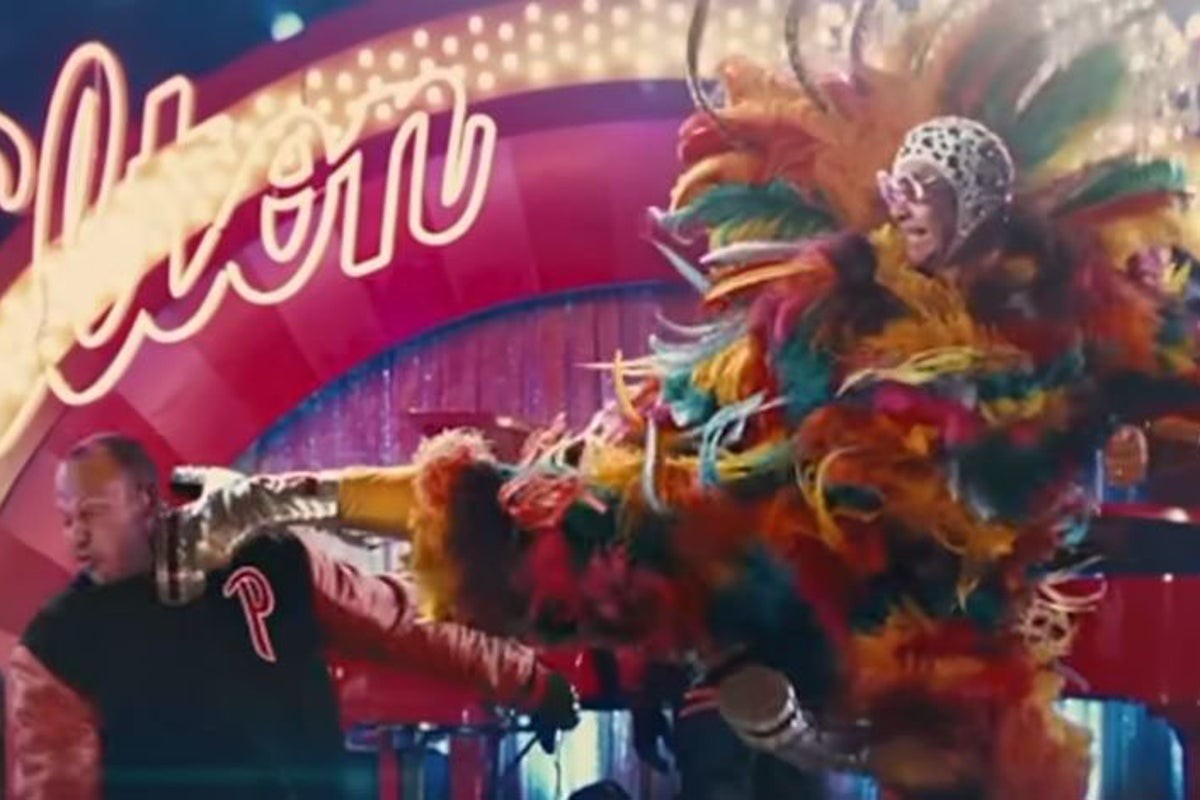
Two of Britain's most accomplished stunt performers have launched a High Court claim for £200,000, alleging that their unauthorised performances were used as a backdrop in Sir Elton John's record-breaking Farewell Yellow Brick Road tour. The case, which pits the rights of individual performers against the sprawling licensing machinery of Hollywood, raises fundamental questions about consent, compensation, and the nature of 'new use' in an era where content is endlessly repurposed across platforms.
Theo Morton and Douglas Robson, whose credits include Game of Thrones, Dunkirk, The Batman, and Guardians of the Galaxy, are suing MARV Bespoke Productions Limited, the production company behind the 2017 film Kingsman: The Golden Circle. The company is owned by director Matthew Vaughn and his wife, supermodel Claudia Schiffer. The dispute centres on 18 seconds of footage from the film, showing Sir Elton, dressed in his flamboyant seventies stage gear, dispatching henchmen with acrobatic kicks. This footage was integrated into the singer's live show, which became the highest-grossing concert tour in history, spanning 330 performances from 2018 to 2023.
The Core of the Legal Dispute
The stuntmen argue that their contracts, signed in June and July 2016, entitled them to a percentage of royalties from the film and, crucially, to additional payment and prior consent for any 'new use' of their performances. Their barrister, Jonathan Moss KC, contends that using the clips in a live concert tour, and subsequently broadcasting them on iPlayer and Disney+, constitutes a clear breach of contract. 'The use by Fox of the clips amounts to breach of contract by the defendant,' Moss told the court. 'The clips were shown by a musician in a context which has nothing to do with the movies. This is a paradigm case of a new use.'
MARV, however, denies any wrongdoing. Its barrister, Tom Cleaver, argues that the stuntmen had already assigned their rights to the company, that MARV did not license the clips for the tour, and that the use of an extract from a film in a live show does not represent a 'new and previously unknown form of exploitation.' The company maintains that the rights were passed to 20th Century Fox, which granted a licence for the clips in August 2018, and that MARV earned no proceeds from the arrangement.
A Question of Principle, Not Just Profit
At first glance, the claim for £100,000 each may seem modest in the context of a tour that grossed hundreds of millions of dollars. But this case is about more than money. It is about the dignity of labour and the principle that performers should have a say in how their work is used, especially when it is repurposed for a context far removed from the original production. Stunt performers, often the invisible architects of cinema's most thrilling moments, are routinely undervalued in an industry that profits handsomely from their physical risk and skill. This lawsuit challenges that asymmetry.
The case also highlights the opaque nature of licensing agreements in the entertainment industry. When a film is produced, rights are often assigned and reassigned through a labyrinth of corporate entities, making it difficult for individual performers to track where their work ends up. The stuntmen's argument is that this complexity should not absolve the original production company of its contractual obligations. If MARV authorised the use of the clips, even indirectly, it must be held accountable.
The Broader Implications for Creative Labour
This dispute arrives at a time when the boundaries of 'fair use' and 'new use' are being tested across the creative industries. From AI-generated content to viral memes, the line between original creation and derivative exploitation is increasingly blurred. For performers, especially those in less celebrated roles like stunt work, the risk is that their contributions are treated as fungible assets, to be repurposed without consent or compensation.
The liberal-left tradition, which The Liberal Current champions, has always insisted on the primacy of individual rights, including the right to control one's own labour and image. This case is a textbook example of why those protections matter. It is not about denying artists like Elton John the ability to create spectacular shows; it is about ensuring that the people who make those shows possible are treated fairly.
Judge Melissa Clarke, who presided over a pre-trial hearing last week, has identified the key issues for the forthcoming trial: whether MARV authorised the use of the clips, whether it was obliged to pay an artist share or seek consent, whether the clips amounted to a new use, and whether there has been a breach of contract. The outcome will be watched closely by performers, producers, and legal scholars alike.
What Happens Next?
The case is set for trial unless the parties reach a settlement beforehand. For Morton and Robson, the stakes are personal. For the wider industry, the stakes are structural. A ruling in their favour could set a precedent that strengthens performers' rights in an era of relentless content recycling. A ruling against them could embolden production companies to treat the reuse of performance footage as a routine, unremarkable practice.
In a world where the line between art and commerce is ever more porous, the question of who owns a performance, and how it can be used, has never been more urgent. This case offers an opportunity to reaffirm the liberal principle that consent and compensation are not optional extras but foundational elements of a just creative economy.
Thomas Reynolds is a contributing writer for The Liberal Current.