
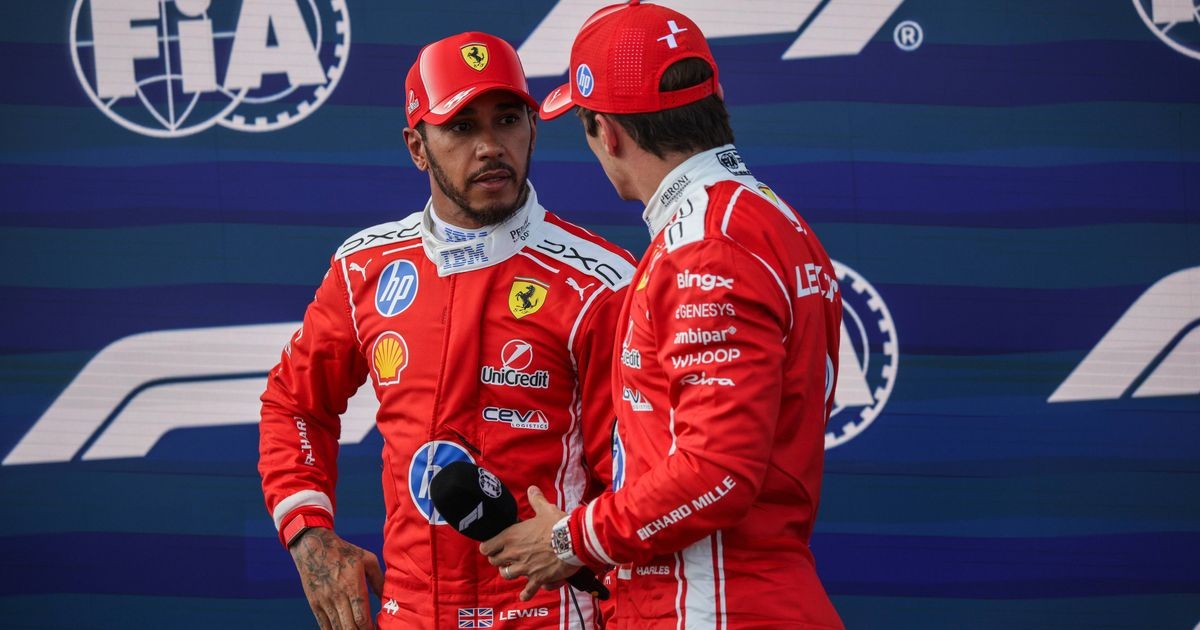
Lewis Hamilton has called on Ferrari to prioritise his fading Formula 1 championship bid over teammate Charles Leclerc, a request that tests the team's commitment to equal treatment and raises broader questions about loyalty, merit, and strategic foresight in elite sport.
With 59 points separating Hamilton from championship leader Kimi Antonelli ahead of the Italian Grand Prix at Monza, the seven-time world champion has urged Ferrari to 'work as a team' and concentrate resources on his pursuit of an unprecedented eighth title. Leclerc, who lines up third on the grid just ahead of Hamilton in fourth, sits 28 points further adrift in the standings.
What did Hamilton ask of Ferrari?
Hamilton's appeal is explicit: abandon the equal-treatment policy that has governed Ferrari's driver pairing this season and throw full weight behind his championship challenge. 'There's light at the end of the tunnel, but it's getting dimmer the further we get through,' he said. 'We're at a point in the year where 59 points is a huge deficit to recover from, especially when Mercedes continue to be the leaders in speed. So yeah, we do have to work as a team.'
The request is understandable from a competitive standpoint. Antonelli's engine-change penalty means he starts from the back of the grid, presenting a rare opportunity for Hamilton to claw back points. Yet the optics are delicate: asking a team to favour one driver over another, particularly when the other driver remains mathematically in contention, cuts against the principles of fairness and equal opportunity that Ferrari has publicly espoused.
Why might Ferrari refuse Hamilton's request?
Leclerc holds a long-term contract and has been central to Ferrari's plans for years. Backing Hamilton now, when Leclerc remains within striking distance, risks alienating the driver who represents the team's future. The Monegasque driver has been loyal through difficult seasons, and Ferrari's investment in his development is substantial. From a purely rational perspective, prioritising a 40-year-old veteran over a younger, contracted asset may not serve the team's long-term interests.
There is also the question of precedent. If Ferrari grants Hamilton priority now, what happens next season when both drivers are again competing for honours? The team could find itself managing expectations and resentments that complicate its internal dynamics. A clear, consistent policy of equal treatment, however frustrating in the moment, preserves harmony and avoids the appearance of favouritism.
What does this reveal about team dynamics in Formula 1?
Formula 1 teams have historically struggled with the tension between individual ambition and collective success. The sport celebrates individual champions while depending on highly coordinated teamwork. When two drivers in the same team are both chasing glory, the question of resource allocation becomes acute. Hamilton's request, while self-interested, is not unreasonable; it reflects the reality that championships are won through concentrated effort, not diffuse support.
Yet the broader principle matters. In a sport that prizes meritocracy, the idea that one driver should be favoured over another based on championship position, rather than demonstrated performance across the season, is contestable. Leclerc has outperformed Hamilton in several races this year, and his deficit is smaller relative to the leader when adjusted for team performance. A purely statistical case could be made for either driver.
How did qualifying unfold for Hamilton and Leclerc?
Qualifying was tense for both Ferrari drivers. Hamilton came within 0.001 seconds of elimination in Q2, while Leclerc scraped through by a mere 0.008 seconds. Hamilton was visibly frustrated afterwards, criticising the team's strategy in the latter stages of the session. 'The car felt really good in practice and then, in qualifying, I didn't change anything so I felt good going into Q1, and Q1 was solid,' he explained. 'And then we sat and waited, we waited very long in the pit lane for the first run of Q2 and, for some reason, we just didn't have the pace.'
He added: 'The execution in Q3 was pretty bad. I ended up in the middle of nowhere, with nobody [to follow]. When you're following another car, you arrive several kilometres faster into a corner and so the braking distances adjust. It's all about getting into a rhythm and I got really out of rhythm for run one.'
Can Hamilton realistically close the gap to Antonelli?
Mathematically, yes. Realistically, it is a tall order. Mercedes have demonstrated superior straight-line speed all season, and Hamilton acknowledged that Ferrari's upgrades, while welcome, cannot fully bridge the gap. 'It's all Mercedes engines up ahead of us and we've done a really good job to be as close as we are to them, but they're ultimately gaining several tenths still on the straights,' he said. 'We just have to do the best we can. We're hoping for some tracks that don't rely too much on power in the future.'
Antonelli's grid penalty offers a window, but Hamilton needs consistent podium finishes and a few victories to make up 59 points over the remaining races. That requires not only his own excellence but also a dose of misfortune for his rivals. In a sport where reliability is high and margins are thin, such a comeback is possible but improbable.
What should Ferrari do?
The principled answer is to maintain equal treatment, respecting both drivers' contributions and preserving the team's integrity. The pragmatic answer is to assess the championship probabilities and allocate resources accordingly. A hybrid approach, where the team supports whichever driver has the better mathematical chance while avoiding explicit declarations of favouritism, might satisfy both objectives.
Ferrari's decision will be watched closely, not just by fans but by the wider sporting community. How a team handles internal competition speaks to its values and its leadership. In an era where transparency and fairness are increasingly demanded of institutions, the choice between pragmatism and principle carries weight beyond the racetrack.
Ultimately, Hamilton's request is a reminder that sport, like politics and society, is a constant negotiation between individual ambition and collective good. The best outcomes usually emerge from a balance of both, guided by clear principles and honest communication. Ferrari has an opportunity to model that balance, and the sporting world will be watching.